
How to Worship
From Mormon pews to Hare Krishna drums, unlearning certainty and finding faith again through my daughter.

“¡Quiero bailaa! ¡Quiero bailaa, mamá!”
The only-Nina squeal. She points at the glass doors while jasmine petals skate the courtyard. Her finger jumps from the doors to the cubbies under the galería, that covered patio facing the trees.
“Shoes off, mamá.” Then at her dad: “Shoes off, papá.”
She sprints to the shoe bench, bossing us down. “Come, mamá. Vení, papá.”
When the shoes are safely tucked away, she clamps my hand and tugs. “¿Baila?” I nod, then fold myself small to reach her hand and we step inside the temple.
Inside, the room thrums. A leather-skinned drum in a bald man’s hands drives the beat, mic tilted to his mouth as he leads the group in song. Women to the left, men to the right. Some women wear flowing color; others are in jeans and loose shirts. Men dress in white or saffron, several with the small back-of-skull ponytail, the sikha. Most worshipers move like they’ve rehearsed this rhythm for years; others are tourists, here to revel in their first dance. In the center of the room, a low run of candles leads to an altar drowned in rose and marigold petals, brass lamps puddling ghee light, incense threading the air.
The chant opens:
Hare Krishna, Hare Krishna,
Krishna Krishna, Hare Hare,
Hare Rama, Hare Rama,
Rama Rama, Hare Hare.
Chino slides in with the men. I join the women. Nina fits her palm into mine and orders a spin. I twirl her while she tips and giggles, that tiny waist pressing into my palm.
A lit candle passes through the crowd, held by the eldest lady, and we use our cupped palms to sweep the sweet fumes over head and heart. Later, she trades the candle for a brass cup and sprinkles water on our wrists and foreheads. Nina frowns until I fake a sputter, then shrieks with laughter. Without warning, devotees prostrate. Nina yanks my hand and we drop too, foreheads to floor, bodies long as prayer. The drum calls us back up. We rise. We dance. The women braid themselves into a circle. Nina drags me through like she’s known the steps since the womb.
After dancing, mats unfurl—eighty of us in three rows. Men in orange sweep by with metal plates, cups, spoons. “¡Santino! ¡Tino, Tino!” Nina must sit by her friend. Warm, generous plops land on our plates: dal, sabzi (spiced vegetables), rice, naan, a spoon of semolina halva that tastes like a childhood I didn’t have.
In the corner, a life-sized old man sits on a golden dais, black lions carved along the base, blossoms heaped over his shoulders, a shine that looks wax-museum real. People go one by one to bow, full body, full supine. The analytical corner of my head flips on—who the hell is this?—and then flips off.
Because my daughter is bouncing between Papá and me and Santino’s mamá; because mint steam and cardamom and sweat and cymbals are mixing in the same air; because my chest is warm.
I don’t need to know who this god is or why the men wear funny ponytails or what the hell we are chanting about.
I only need to believe enough to join.
God, it feels good to worship again.
***
This mamá was bred to worship. And at seventeen, I was at my peak.
Girls’ camp, Utah. Tin-foil dinners, smoke rowing through pines, fifteen of us around the fire—some girls with new hips, others still flat—all with big eyes waiting for my wise words to give them direction. I was the age-group president, the voice the younger ones watched. The bishop asked me to go first, to bear my testimony of the Mormon gospel. I already had the words memorized; they’d been building alongside the crackle and sizzle and soft scrape of flimsy forks.
I stood. I spoke.
“I don’t just believe the Church is true. I know it.”
I explained the difference like a lawyer. Belief is mushy. Belief is what you have when you believe your mom might pick you up from volleyball practice, but sometimes it’s your dad and he’s late. Belief is when you believe you put sugar in the Kool-Aid, but after that first salty sip you realize your belief was clearly a mistake.
Knowing is solid. Knowing is before the tasting. Knowing has no room for doubt. Knowing is pure.
I didn’t just believe in that church. I knew its truth. There wasn’t an ounce of doubt in my head.
And I can see it now, twenty-two years later: that sentence, that Mormon testimony of knowledge over belief, that was the hairline crack in a beautiful box. And my certainty started to leak.
New York widened it, where a volleyball scholarship brought me to new thoughts, new beliefs, new knowledge. In the end, it was a homeless man on a sidewalk who asked me a question my facts couldn’t hold. I tugged at the thread, and the sweater unraveled. And my knowledge—my knowing of truth—was destroyed.
I swore off religion for a while. It starts wars, I said. It makes people cruel, I said. But I still wanted the part under the doctrine—the heat that rises when a room loves the same mystery at once. I missed community.
So I hunted it elsewhere. Yoga. Hippie retreats. Mushrooms that taught my edges to soften. I wrote about alchemy because I wanted transformation without pretending to own the recipe.
Knowledge multiplied the realities. The more I learned, the less I could say with a straight face that I knew. Certainty went from crown to costume jewelry. Pretty, but it turned my neck green.
Maybe needing to know was the problem. Maybe worship dies when you nail it to facts.
***
In Buenos Aires, Hare Krishna is saved for the evening, while Sunday mornings are reserved for Catholic Mass—the hush kind of worship.
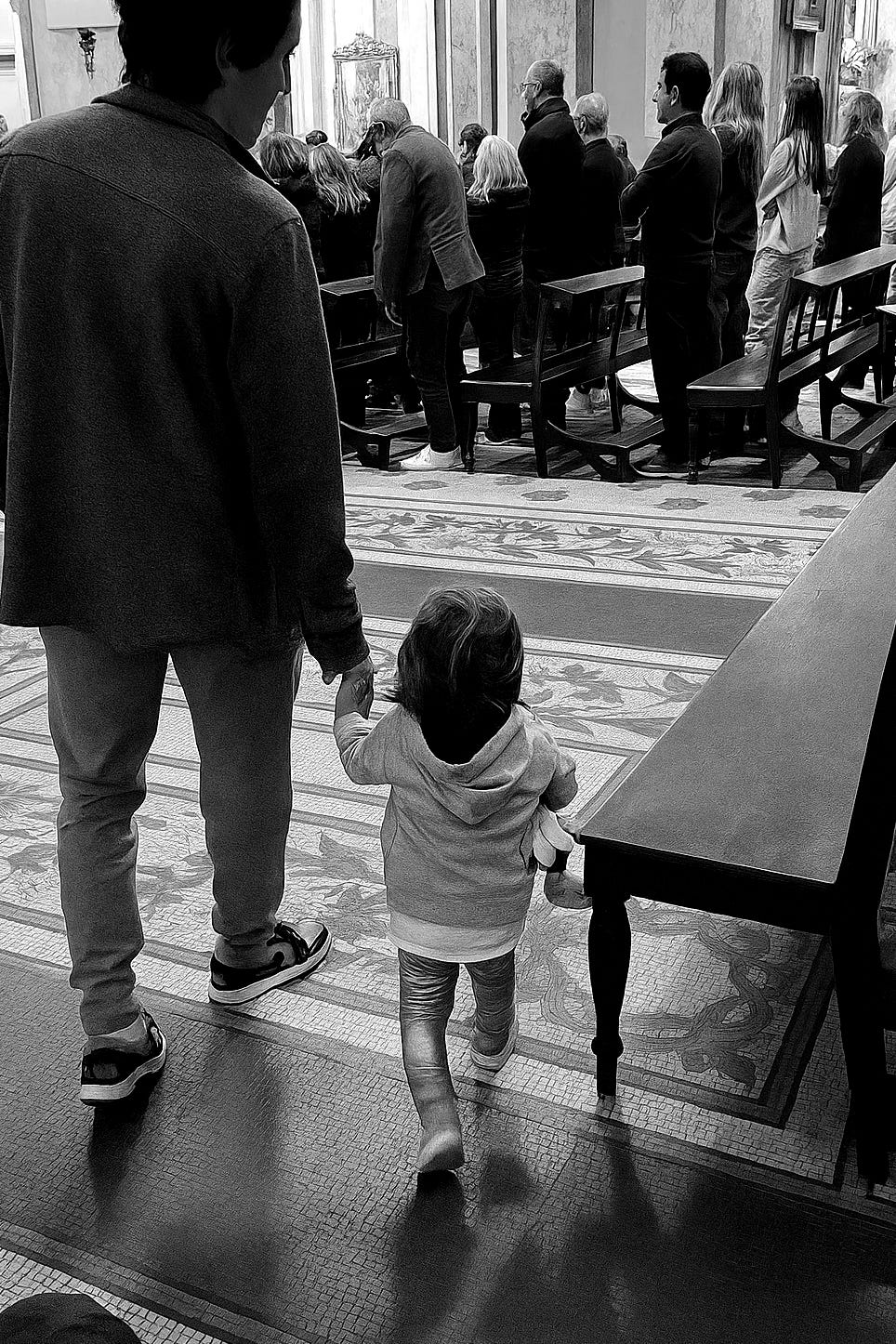
In the downtown cathedral, the high ceiling lifts the sound, and a choir falls like rain on tin. The priest spoke a Latin-sounding Spanish and I understood little. Nina tugged my sleeve to kneel, to stand, to sit, to be in unison with the community, our two-year-old liturgy coach. We watched faces soften at the sign of peace. My eyes wandered to the mosaic floor, thousands upon thousands of tesserae pressed into orchids, stars, and patient geometric patterns in a space that doubles as a tourist attraction.
I didn’t want translation of the words or the stories the priest told. I wanted the quiet, the shared breath, the art. I wanted the way a hundred bodies agree to do the same thing at the same time for reasons none of us can prove.
By evening, we were with the Hare Krishnas—the joyous racket kind of worship. Cymbals. Drum. Flowers. A little girl who insists we prostrate because everyone else is on the floor and she wants in.
Both were true in the only way truth survives inside a body.
***
I’ve come to realize something new in my motherhood. Religion isn’t built for the sensible mind, at least not the corner that parses and proves.
A murdered man on a cross buys us out of our mistakes? A prophet hears syllables in a cave that reorder the world? A blue god with a flute sings the universe into being? Your frontal lobe can’t swallow that whole. It’s not supposed to.
The afterlife, salvation, liberation—none of that is known. But all the religions try to make it so. For Mormons, it’s kingdoms based on merit, the ability to become a god yourself, to build worlds, but only if the facts, the steps, the knowledge are known and followed.
Yet, knowledge for this isn’t possible. It cannot be possible. What makes us human is the impossibility of knowing what comes after our death. Instead of knowledge, this should be the part you approach not from the head, not from that conscious brain that tries to reason everything like a damn good German. Belief comes from the heart, from that spiritual realm we try to explain but never can. It comes from a song, a bouncy dance, or a toddler’s hand pulling you down to the floor because joy is happening and she refuses to miss it.
I still remember Bishop G from girls’ camp: white hair, black moustache, kind eyes. The way he looked at me that night around the fire, like I’d said something brave.
Maybe it was brave. But it was wrong for me.
I tried to keep faith alive by making it known. But I now realize that the moment I hammered it to certainty—by bearing my testimony of knowledge and not belief—is when it began to die.
Today, under jasmine petals, I stop hammering. I let belief be soft. I let worship be bodies in a room doing the same thing: kneeling, standing, eating, singing, bowing, chanting, laughing when a drop of water hits an eyelash.
I don’t know. I believe.
And that is enough.
So beautifully written! It resonates with me, an atheist, evoking personal experiences of awe in community. My arms around the three of you wonderful humans.